- The Inbox
- Posts
- Why Your Pop-Up Is Leaking Subscribers (And What Actually Fixes It)
Why Your Pop-Up Is Leaking Subscribers (And What Actually Fixes It)

Max Sturtevant
February 18, 2026

The Inbox Newsletter

Our Feb/March 1:1 consulting cohort closes TODAY. If you want consulting with my team and myself on scaling your email channel, apply before tomorrow here.
Hey, it's Max from the Inbox Newsletter.
Most brands treat their pop-up like an afterthought.
It fires five seconds after someone hits the homepage. It says "Get 10% off your first order." There's an email field, a button that says "Subscribe," and a little X in the corner that half the visitors click immediately.
And then they wonder why their list grows at a snail's pace.
Your pop-up is the very first moment of personalization your brand has with a new customer. If you're blowing it with a generic experience, you're leaving serious money on the table before a single email even gets sent.
The brands crushing list growth right now are doing something way more interesting. And it comes down to one highly slept on principle: micro-commitments.
Key Takeaways:
Single-step "enter your email" pop-ups get the lowest possible conversion rate
Asking a question before asking for an email triggers the Zeigarnik Effect (the compulsive need to finish what you started)
Quiz-style pop-ups collect segmentation data at the point of entry, making your welcome flow way more effective
Gamified pop-ups like scratch-to-win create interactivity and commitment loops that boost conversion
The best pop up software we use for all of our clients
The Psychology: Ask a Question Before You Ask For Their Information
There's a well-documented bias in human psychology called the Zeigarnik Effect.
People have a compulsive need to finish things they've started. Once you begin something, your brain creates almost physical discomfort until it's resolved. It's why you can't watch half a Netflix episode and walk away. It's why you always answer a trivia question even when the stakes are zero.
Quiz funnels weaponize this.
When a pop-up opens with "What's your #1 health goal right now?" and gives you four options to click, you're not asking for an email yet. You're asking for a micro-commitment. One click feels low stakes.
But that one click starts a sequence the visitor now feels compelled to finish. By the time the email field shows up, they're now thinking "I need to see my result." The email is just part of completing what they started.

Example: Grazly’s Quiz Pop Up
Grazly runs a quiz pop-up that asks visitors to self-select between "Autoimmune Recovery," "Gut Repair," "Skin Restoration," "Mental Clarity," or "Strength + Stamina."
This is a smart way to collect segmentation data at the point of entry.
If you want to be really advanced, make sure the welcome flow that follows isn't generic. Grazly specifically has food and skincare lines. This is a great way to segment customers based on their interests.
That's a double win: higher opt-in rates because of the micro-commitment psychology, and higher welcome flow conversion because you can taylor the messaging to match why the person subscribed in the first place.

Example: Healthy Sol's Skin Concern Quiz
Healthy Sol runs a similar play on their tallow soap and skincare. The discount is locked in at simple 10% off, but to claim it, you tell them your primary skin concern: Dry skin, eczema, acne, or a general skincare swap.
Same result as with Grazly: the subscriber self-selects into a segment before they even get their first email.
Their team now knows exactly which products to lead with, which pain points to address, and which testimonials will resonate most. That's not just a pop-up. That's the beginning of a personalization engine that makes every email after it more effective.
The New Format Worth Watching: Scratch-to-Win

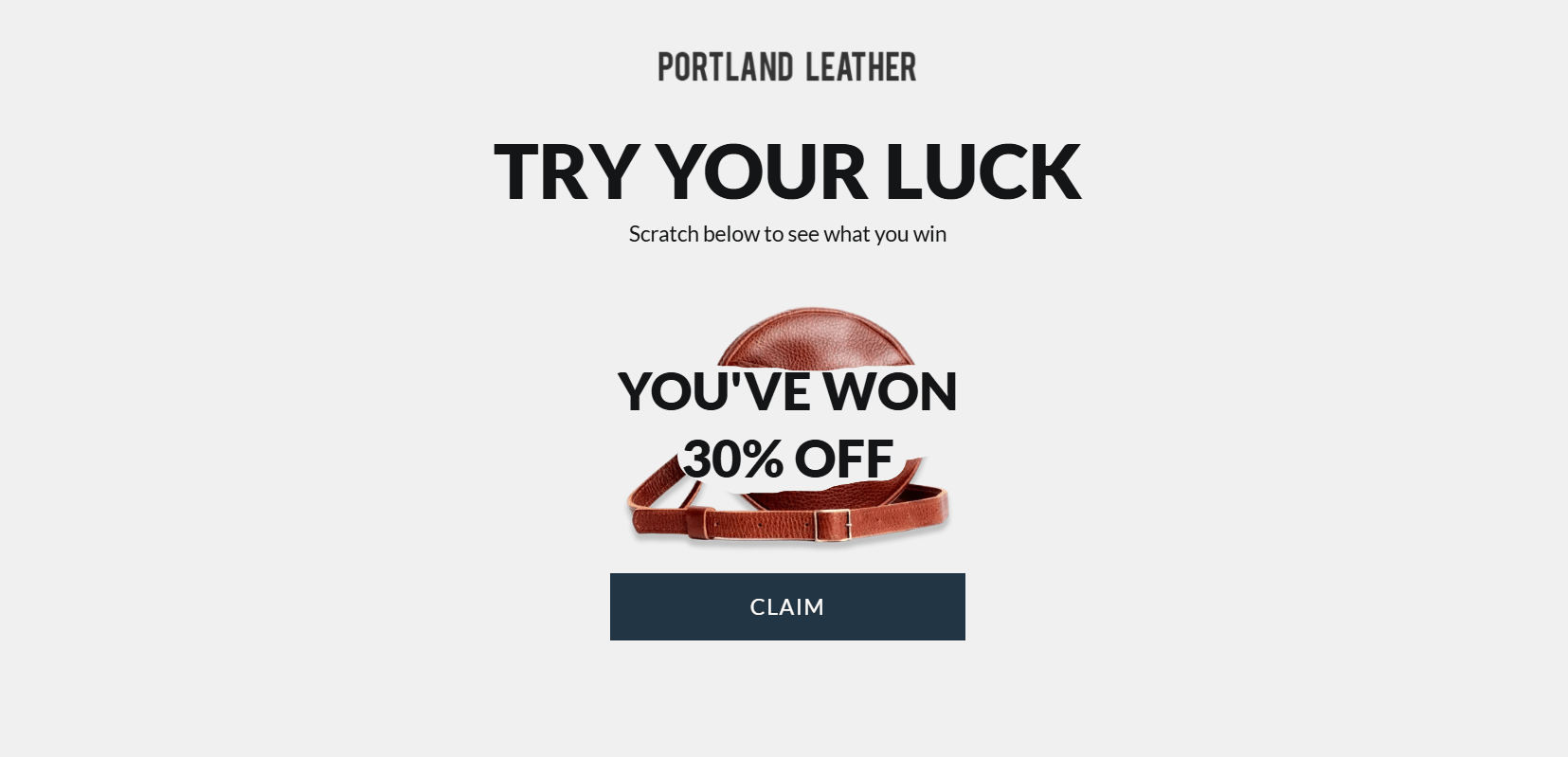
There's a new pop-up format starting to show up that I think is genuinely brilliant.
Portland Leather is running one where you land on the site, a pop-up appears with a product image and the words "Try Your Luck" with a scratchable area. You scratch away the product to reveal your discount. In this case, 30% off.
What's happening here is pure gamification backed by multiple psychological triggers firing at once. There's unpredictability because you don't know what you'll win. There's interactivity because you physically do something. And there's a commitment loop because you scratched, you won, and now there's a "Claim" button your brain wants to click.
The conversion intent from someone who just "won" something is dramatically higher than someone who was just offered a passive discount.
How To Create These Pop-Ups
The question is never whether to add friction. It's whether the friction you add creates value or just annoys people.
A quiz question or a scratch mechanic creates value. It makes the experience feel personalized, interactive, and worth completing.
All of the examples I showed you today were built using Alia. It's the pop-up software we use for clients when we want to go beyond basic email capture. Quiz funnels, scratch-to-win, multi-step flows with segmentation built in.
You can build all of it without needing a developer, and the data flows directly into Klaviyo so your welcome flow can actually use the information you collected.
It’s a no brainer.
Our Feb/March 1:1 consulting cohort closes TODAY. If you want consulting with my team and myself on scaling your email channel, apply before tomorrow here.
Email Inspiration Of The Day
Brand: Brez
Email Design: https://drive.google.com/file/d/1vcsm9MjtAL9ehHgnZ56PFw6MX0kRdZxx/view?usp=sharing
Notes:
Brez never does $10 OFF of $5 OFF or anything like that... they only say $10 "store credit.” Same offer but way better framing and different psychology.
Reply to this email if you have any questions or further content you want covered.
Cheers,
Max Sturtevant | Well Copy
How I Can Help You:
Work With My Agency To Manage Your Email / SMS: Learn More »
Get 1:1 Consulting With My Team & Myself Learn More »
Free & Paid Guides / Resources: Learn More »
Join My Team: Apply Here »